

How Much Trust Does Your Team Need?
Hint: the right answer isn't "as much as possible"

Note: This post is Part One in a three-part series on Unpacking Team Trust. In the next two posts, I’ll tackle the questions “How Do You Build Trusting 1:1 Relationships on Your Team?” and “How Do You Build Collective Trust As A Team?”

Many years ago, I was working with the leadership team of a large investment services company with a big problem: one of its three lines of businesses was languishing. This was a mutual funds provider whose products were distributed through three channels: direct to consumer; via third party aggregators such as Schwab or Fidelity; or through retirement plans managed for employers. While the first two lines of business were doing great, the third was faltering.
At several strategy retreats, we kicked around how to fix the employer retirement accounts business but never seemed to get anywhere. Eventually it became clear why: most of the leaders didn’t want to fix the business.
That the employer retirement business was struggling wasn’t a surprise—that was an industry-wide trend at the time, so the business was fighting gravity. Rather than agreeing that the business was facing external headwinds and pulling together to find a solution, they kept calling it “Mike’s problem,” treating it as a personal performance failure. In a tough internal competition for influence, budget, and career advancement, these leaders had zero interest in solving the problem. They just wanted to hang it around Mike’s neck.
Making trust tractable
Most conversations about trust don’t get very far for an important reason: People tend to discuss trust as if its one thing, which is wrong. Trust is such an abstract concept—like justice, truth, or beauty—that it’s hard to make concrete progress on it.
To make trust tractable—i.e., something you can do something about—you need to be disciplined about unpacking it along three key dimensions: 1) the overall level of trust you need to meet your goals; 2) the specific one-to-one relationships that need to be elevated among the team—and how; and 3) the total culture of trust across the team. This three-part series addresses these issues in that order.
The Team Trust Continuum
To begin with, there are five basic levels of the Team Trust Continuum:
Active distrust: In some situations, such as the opening anecdote here, team members are actively undermining one another.
Passive distrust: More often, distrust is sneaky—that is, people undermine one another in less visible ways, such as withholding important information or making subtle digs behind their back.
Neutral trust: This entails taking a “wait and see” attitude about teammates.
Transactional trust: Organizations with healthy cultures exhibit a general sense that if someone is on the bus, they must be qualified and have good intent, or they wouldn’t have gotten in. When you meet a new teammate for the first time, you can feel safe assuming they belong there (unless they prove otherwise).
Intimate trust: This is a high bar. Intimate trust is a deep, abiding faith that a teammate truly has your back when the going gets tough. You are confident that they respect and like you, and will take your interests and well being into account in any important interaction.
Team trust is both general and specific
It is important to note that team trust is both a generalized condition and a highly specific one. That is, each team has a landscape of trust that derives from three levels: the larger organizational culture, the team-specific culture, and a collection of one-on-one relationships. Team leaders need to work mostly at the last two levels under their direct influence to build the trust environment that’s needed.
So: How much trust does your team need?
Okay, now let’s get back to the question in our headline. If this feels like a trick question, it is. It’s easy to think that the correct answer is “as much as possible,” but it’s not.
Different teams have different trust requirements to meet their goals. If you’re on a regional sales team that meets once a quarter to share market insights and practice tips, then the level of trust required is pretty basic. You just need to feel secure your teammates aren’t going to steal your leads. If, on the other hand, you’re a Navy SEAL, then your very life could depend on the skill and reliability of the person standing next to you. Most work teams are somewhere in between these extremes.
As a general rule of thumb, team leaders should work to root out all distrust on a team—whether active or passive—and seek to get the entire team at least to the level of transactional trust. The question then becomes: when, where, how, and why to invest in creating intimate-level trust, which is very powerful—but also very costly and hard to build.
Build intimate trust when vulnerability is required for success
In all but the most rare circumstances, you cannot build intimate trust across an entire team. There just isn’t enough time, and most working relationships don’t need it to be successful anyway. However, there are situations where intimate trust is absolutely required to meet your goals. The key is realizing when those conditions arise and to lean in with skill.
A few years ago, I was working with the leadership team of a large healthcare business. As in the opening anecdote, one part of the business was struggling—but in this case it was the largest part of the core business. Moreover, it was crystal clear that the leader of that market didn’t “own” the problem alone. Rather, the sluggish growth was due to a complex web of issues related to marketing, supply chain operations, technology, and talent. Everyone agreed that the business leader could never fix their stagnant growth alone—any solution would have to involve coordinated improvements across multiple, interconnected dimensions.
In this situation, each unit leader had to come clean about what wasn’t working in their part of the org. And coming clean meant being vulnerable—being 100% honest about where they and their team could and must do better. Anything short of that wouldn’t have worked.
In this case, the key leaders involved were forced to get real with one another in a way that had never been necessary before. In short, they needed to build a whole new level of intimate trust across five leaders—and fast—if they wanted to succeed.
A useful tool: The Team Trust Matrix
As a leader, you need to understand at a deep level the landscape of trust across your teams. I help leaders do this in a disciplined way using what I call the Team Trust Matrix to examine 1:1 relationships as well as the overall pattern across the team.
The following illustrative diagram shows a typical landscape of trust for a senior leadership team, from my experience with many dozens of them. The majority of bilateral relationships on any leadership team are either Neutral or have Transactional Trust, with a smattering that exhibit Active Distrust, Passive Distrust, or Intimate Trust.1
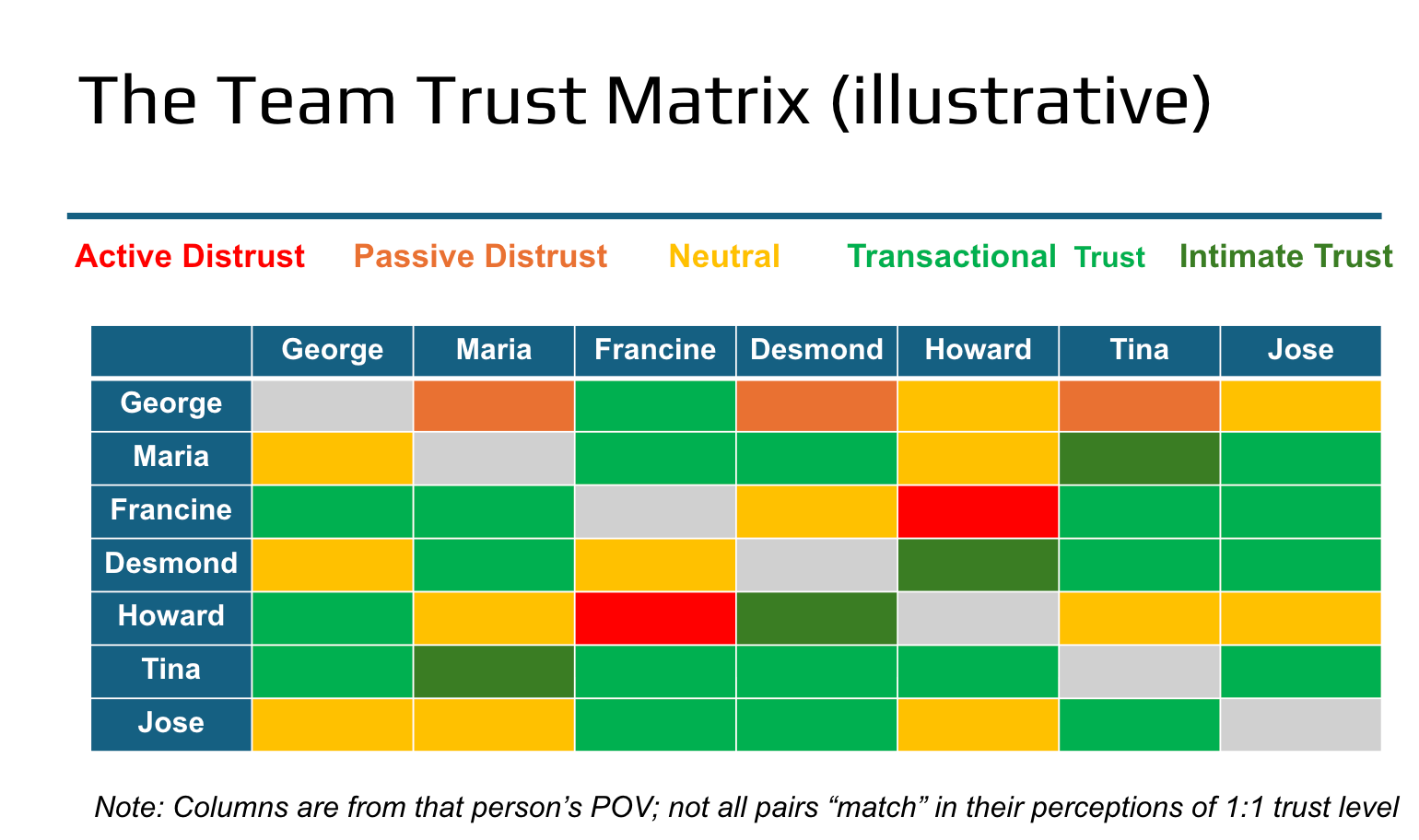
An important point: I never share a matrix like the above with a team whose members are represented in this way. That would be way too hot! Instead, I use this matrix in one of two ways: (1) as a “backstage” tool with the team leader alone, to assess where and how they need to intervene; and/or (2) as a purely illustrative point of conversation for a team to reflect on where they stand.
In this second use case, I share the example matrix above with the team and say something like this:
“This matrix reflects a typical landscape of trust in a team like yours, based on having worked with dozens of them. In my experience, most relationships are good enough, but there are a few broken links in the mix, as well as a few really tight relationships.
How does your team’s landscape of trust compare—in general terms, not naming names, please!—to this illustrative example?”
While this may feel like a risky conversation, it’s almost always a very productive one when skillfully facilitated. In my experience, people are often eager—even relieved—to have a candid conversation about the web of relationships across the team, so long as boundaries are well managed to avoid getting into the blame game.
Building team trust strategically: unpack, then intervene
For leaders looking to build trusting teams, here are a few steps to take:
Don’t tolerate any “broken links.” A critical job of team leaders is to sniff out any cases of distrust among members—both active and sneaky-passive—and to lean into them hard. This takes guts and skill, but is so critical—and something that far too many leaders avoid doing.
Establish transactional trust across the whole team. Transactional trust must be the baseline goal across all relationships in any team. Without this level of trust, it’s unlikely that you can accomplish your goals.
Identify where intimate trust is needed for success. Intimate-level trust across all team members is practically impossible except on the smallest teams and isn’t necessary in most situations anyway. Rather than setting this unrealistic goal, your job as team leader is to identify which specific 1:1 relationships must reach the intimate level in order to meet your goals, and focus on supporting them to get there.
Determine where interventions need to be team-wide versus with specific members. Some of your team-building work will need to be with individual members, some with pairs or sub-groups, and some with the full team. Parsing out these distinctions is part of your job as team leader.
Identify which kind(s) of trust need to be developed. There are four main factors of trust: capability, reliability, transparency, and humanity. If trust is lacking between people, it’s critical to know which factors are in play, so that appropriate actions can be taken. For example: If I don’t trust you because I don’t believe you’re good at your job, then no amount of friendly banter about our families and hobbies is going to fix that.
Use proven trust-building techniques. The literature is clear on one critical point: team trust is built by accomplishing tough tasks together, not by fancy dinners or going to escape rooms!
I’ll be elaborating on several of the above points in my next two posts.
In Part Two of Unpacking Team Trust, I’ll tackle the question “How Do You Build Trusting 1:1 Relationships on Your Team?”
In Part Three, I’ll look at “How Do You Build Collective Trust Across Your Team?”
An aside: In my experience, leadership teams tend to have the lowest levels of trust (due to internal competition), followed by cross-functional teams (due to clashing professional mental models)—with the highest levels of trust typically found among operational or project teams within the same department.
I trust you.