

How Do You Build Trusting 1:1 Relationships on Your Team?
Use the Four Factors to build trust with intent

Note: This post is Part Two in a three-part series on Unpacking Team Trust, which are best read in order.
Before reading this post, I recommend that you read Part One, where I tackle the question “How Much Trust Does Your Team Need?”

Imagine this situation: You’re at a leadership team retreat and on the morning of the first day, before you head to breakfast, you receive a small stack of Valentine’s Day cards from your colleagues under your hotel room door. Each one shares something that your colleague appreciates about you—and one way they would like to see your relationship improve.
A bit unusual? Sure. Kinda corny? You betcha. A useful way to spark conversations for the coming day? Absolutely.
Believe it or not, this is something I’ve done with the leaders of a large healthcare business—and yes, it worked. But before we get under the hood on that situation, let’s look at how we got there…
“I don’t trust Mark.” (Okay, but… why?)
It’s not unusual to hear a colleague say—sometimes in hushed tones—that they don’t trust a colleague, to which we nod our head in sympathy. But rarely do we take the next step of digging into the specific reasons. More often, we take the notion that someone isn’t trustworthy as a moral failing on their part—which is possible, but not a given.
Now, imagine that you ask your colleague the question “Why—specifically—don’t you trust Mark?” and they give you one of four answers:
“I’m just not sure that he and his team have the skills to get the job done.”
“He and his team don’t show up for me when I need them.”
“I can never tell what’s really going on in his part of the organization.”
“Our values are very different, and I’m not sure he’ll treat me well when it matters.”
These are four wildly different reasons, calling for different responses. Yet, if we don’t go to the trouble of understanding the root cause(s) of distrust, there’s not much we can do to address the situation.
A useful tool: The Four Factors of Trust
My former Deloitte colleagues Ashley Reichheld and Amelia Dunlop share the best framework I know of for unpacking trust in their book The Four Factors of Trust: How Organizations Can Earn Lifelong Loyalty. While the main focus of the book is how whole organizations can build trust with customers and employees, the frame is equally helpful in building trust among team members.
Following from the answers above, the Four Factors1 are:
Capability: I trust that you have the skills to do your job well
Reliability: I trust that you will meet your commitments—or tell me in advance when that’s not possible
Transparency: I trust that you will be open and honest in providing information that matters to me
Humanity: I trust that you are a decent person who has positive intent toward me
Looking at these four very different factors, it’s clear that tactics to build trust must match the kind of trust gap that exists.
For example:
If I think you are trying to steal my job from me (a humanity challenge), no amount of information about how capable you and your team are is going to help (and might even hurt!).
If I think you don’t follow up on your promises or show up when I need you (a reliability challenge), then sharing personal stories about our families can only help so much.
If you and your team hoard information that’s important to me and my team (a transparency challenge), your promises that you’ll meet all the deadlines you commit to still won’t make me trust you completely.
If your team is delivering sub-par work on a regular basis (a capability challenge), then you coming clean and being apologetic about it is nice but still leaves me skeptical.
Whenever a trust gap exists between colleagues, as team leader you need to identify the root cause(s) and craft targeted interventions. While this may seem brutally obvious, it’s also something that leaders rarely do!
As team leader you need to identify the root cause(s) of distrust and craft targeted interventions accordingly
Using the Four Factors to increase 1:1 trust among teammates
In my last post, “How Much Trust Does Your Team Need?”, I lay out the case that all team relationships need to reach the level of transactional trust, while the higher level of intimate trust is required only when people need to get truly vulnerable to solve important problems together.
Here’s a paraphrasing of the Valentines’ Day assignment that I gave to all the participants at the leadership team retreat2:
Pick up to three colleagues with whom you would like to have a closer working relationship in order to improve business performance.
For each person, please note three things on this (blank) card:
the specific business reason to improve the relationship (e.g., “if we understand each other better, our teams can handle customer challenges more effectively together”):
at least one thing about the other person that you appreciate today; and
at least one way in which you hope to improve your working relationship with that person tomorrow.
Overnight, our team gathered up all the cards, recorded them, and re-sorted them for delivery. In the morning, we did selected “matchmaking” of specific 1:1 pairs that we knew were critical to business success—and where the participants had each identified one another as peers they would like to build greater trust with.
We gave each pair a conversation template and a half hour to discuss. The template said something like this:
For your conversation, follow these steps:
Look at the business reason(s) that you chose for building trust and see how they line up. To the extent needed, align your two statements and re-write as one statement that clearly lays out the specific business reason why it would be beneficial for the two of you to build greater trust.
Person #1 reads their card to Person #2, with the appreciation and the desired change—adding some color commentary about how they came to these comments.
Agree on which factor(s) of trust are involved in the desired change.
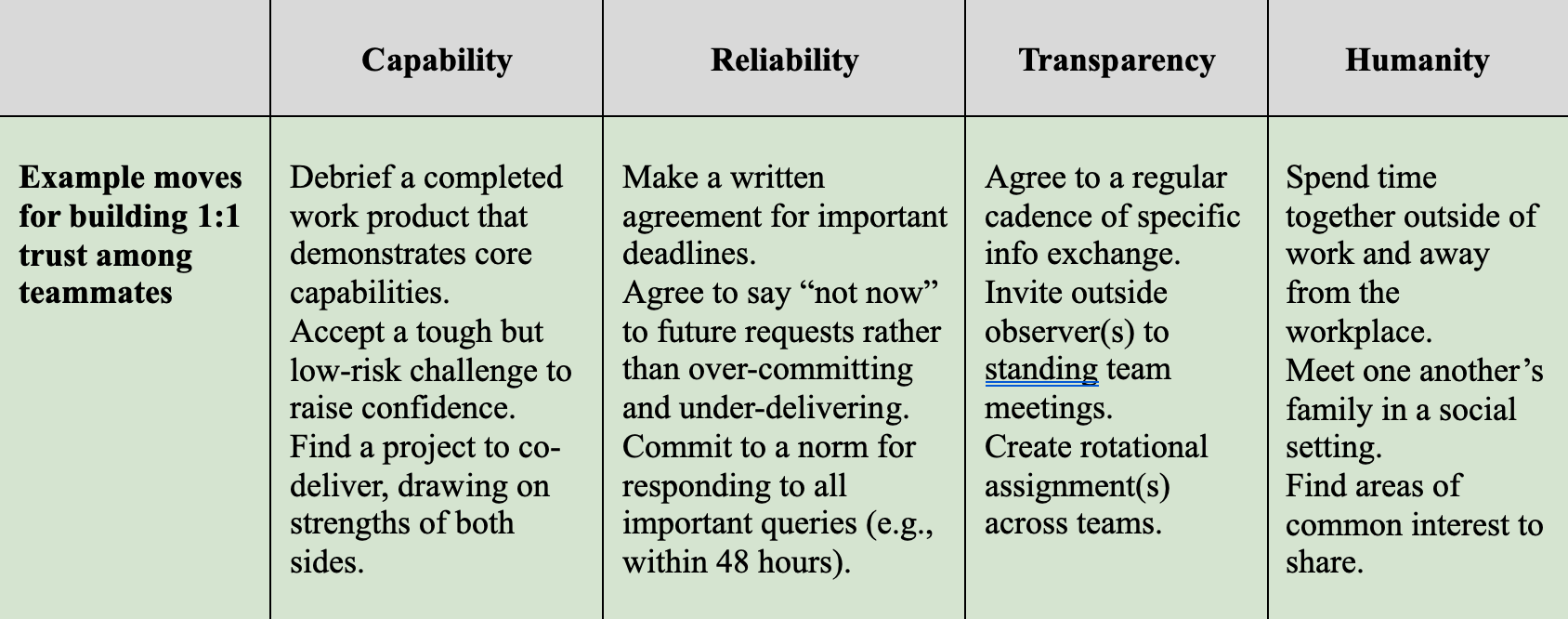
Work together to identify at least one specific action to take to build trust, using the below table of examples as a starting point.
Repeat steps #2-4, with Person #2 reading their card to Person #1, etc.
As a further aide to conversation, we provided a table of illustrative “moves” that could be made to build trust, depending on which factor(s) were in play.
I can see some of you shaking your heads from here: “This would never work!”
Oh, yes it will—and you’d be surprised how well. Most people are hungry for genuine conversations to clear important issues more effectively. Sure, people can react to a setup like this with nervous chuckles at first. But after a minute or two, they get over it, roll up sleeves, and get to work.
So much of the art of teeing up these discussions is in the framing and facilitating. This has to be done in a spirit of improving performance together—not a “search for defects,” as so many performance review systems end up being. When you structure a conversation well like this, the results are almost always very productive.
Now, let’s talk about when they aren’t.
Using the Four Factors when trust building is a heavy lift
Sometimes, these conversations can be very difficult, especially in 1:1 situations where:
there is enough distrust (active or passive) between two colleagues that even getting to transactional trust won’t be easy; or
the business situation requires intimate trust with a level of professional vulnerability that’s very uncomfortable (a subjective bar that varies by person)
In these cases, it’s unlikely that the two team members will be able to use the above process alone. They’re going to need some help.
This is where the team leader needs to step in. These situations call for an experienced, neutral facilitator to broker the agreement between the two team members, drawing on higher-order diplomatic and negotiation skills.3 Some team leaders happen to have these skills in spades and can do the job themselves. If you don’t, no worries—you just need to enlist someone who does.
The lazy leaders’ default setting
All of the above is meant to replace the lazy leaders’ go-to move for building trust: a vague attempt to “get to know each other better” by throwing food and drinks and experiences at them.
It is disheartening how many leaders think that building trust is a simple matter of having a few meals together or (if you’re really creative) going to an escape room. In these settings, people loosen up a bit and seem to be having a good time. That nice, warm glow should surely carry over to work, no?
Sure… to a point. A bit of social lubrication is always a good thing among teammates—but it’s also rarely sufficient by itself. Work and personal life overlap, but they aren’t the same thing.
Let’s be clear: we can have intimate trust at work and get great results with people we don’t know that well and wouldn’t choose to hang out with. And we can have serious distrust and poor results at work with someone who could be our BFF if they were our next-door neighbor (especially if we’re in competition for promotion). Both of these things happen all the time.
In my next post, I’ll tackle the topic of building a team-wide culture of trust. For now, it’s enough to note that real trust-building at work is mainly a matter of getting great work done together—and not so much about whether we know the names of each others’ kids or want to hang out on the weekends.
P.S.: sometimes people really aren’t trustworthy
Finally, it must be acknowledged that a lack of trust can be 100% appropriate, such as in cases where:
a colleague really isn’t good at their job, and the gap is too big; or
they are consistently unreliable—and that’s not going to change; or
they flat-out refuse to share mission-critical information with peers; or
their values are corrupt and intent is truly harmful.
In these cases, dear team leader, this is where you earn your pay, step up to the task, and get that team member the hell out of there! (Nicely, of course.)
In Part Three of this series, I’ll look at “How Do You Build Collective Trust As A Team?”
A fine point: In their book, Reichheld and Dunlop talk about these Four Factors as two pairs: Competence (made of Capability and Reliability) and Intent (made of Transparency and Humanity).
Needless to say, you don’t have to use Valentine’s Day cards for this exercise—it just happened to be February 14 when we did this once, so we ran with it!
There is a robust literature on how to manage tough conversations, with excellent training programs to support them. Two quality examples include Crucial Conversations, by Joseph Grenny, Kerry Patterson, and colleagues; and Difficult Conversations, by Douglas Stone, Bruce Patton, and Sheila Heen.